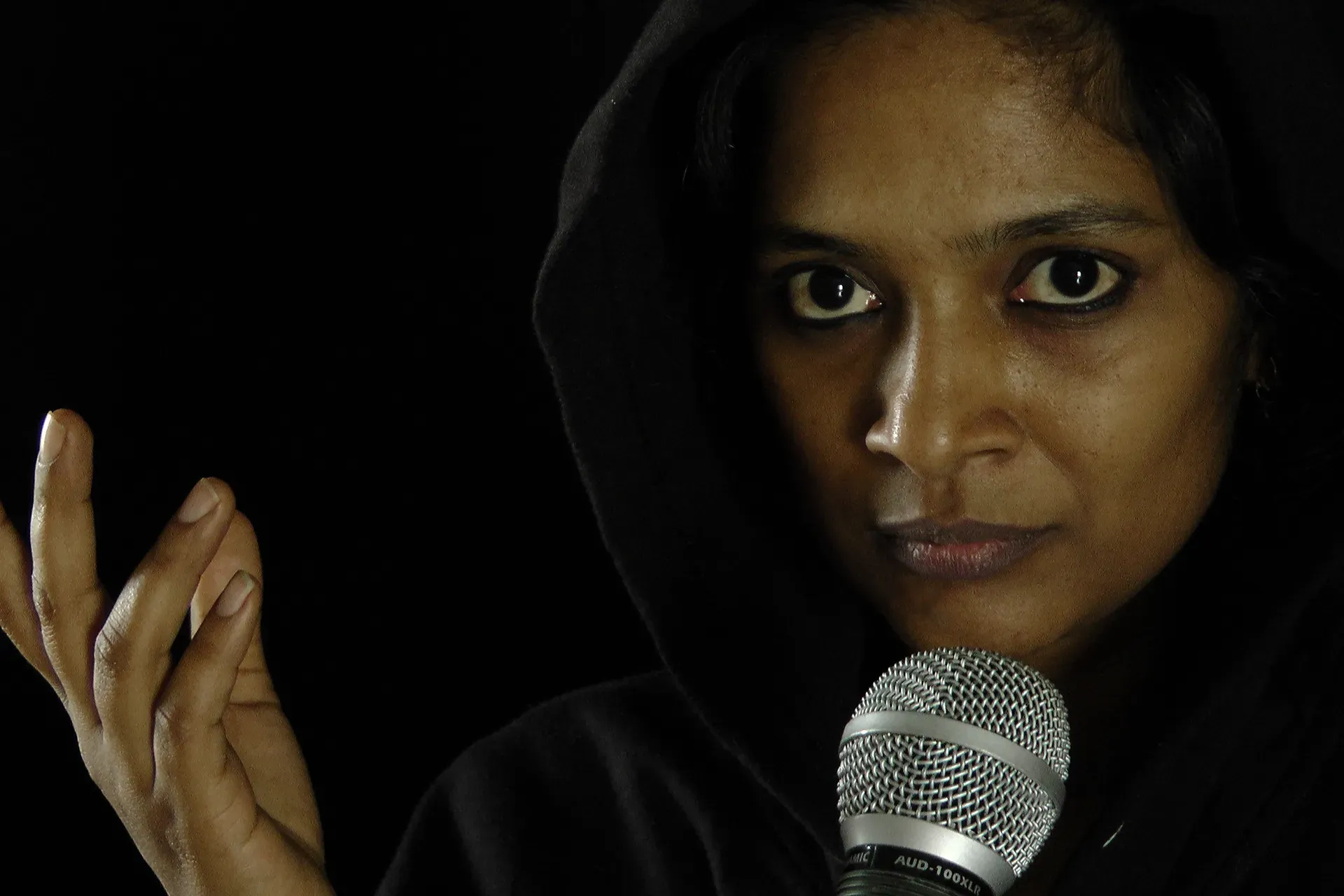
A Flinntheater production in collaboration with Samudra and Jagriti, Bangalore
Created by MD Pallavi (performance and text), Sophia Stepf (direction and text), Swar Thounaojam, Irawati Karnik (text collaboration), Nikhil Nagaraj (live sound), Rituparna Bhattacharya (assistant director), Muhammad Mustafa A and Niranjan Gokhale (light design), Veena Appiah and Shilpa Jagadish (production management and touring), Sandbox Collective (touring), Shamik Sengupta, Amit Bansal, Arjun (photography and design)
2018: Prithvi Theatre, Mumbai: May 24 & 25 / Manipur, Shrine Play House Chorus Repertory: March 22 / Kalapoornima, Bangalore: March 3
2017: Remembering Veenapani (Adishakti): February 5 / Ranga Shankara, Bangalore: November 29 & 30 / Serendipity Arts Festival, Goa: December 22
2016: Miller Theater, Hongkong: February 29 / Bharat Bhavan, Bhopal: October 15
2015: Bharat Rang Mahotsav, New Delhi: February 17 / Jairangam, Jaipur: February 27 / Vinod Doshi Memorial Festival, Pune: February 24 / Bravia Sadhir Festival, Goa: February 27 / The Playhouse Company, Durban (South Africa): September 10 & 11 / Theatre on the Square, Johannesburg (South Africa): September 14
2014: Co-Bank Auditorium Trivandrum, Kerala: January 25 / International Theatre Festival of Kerala: January 28 / META Awards, LTG, New Delhi: March 4 / Smt Sivagami Pettachi Auditorium, Chennai: April 4 / Goethe-Institute, Kolkata: April 12 / Ranga Shankara, Bangalore: April 16 / Prithvi Theatre, Mumbai: April 21 / Akshara, New Delhi: April 25 / India Habitat Centre, New Delhi: April 26 / Ranga Shankara, Bangalore: November 18 / Cochin: December 26 / Ninasam, Heggodu: December 28
2013: Jagriti Bangalore (opening): March 14 - 17 / Ranga Shankara Bangalore: August 17 & 18, NCPA Experimental Mumbai: August 20 / Kalaa Utsavam Festival, Esplanade, Singapore: November 16 & 17
Since the female body will continue to be saleable for as long as we live in a society governed by male heterosexual norms, a play such as C Sharp C Blunt can be assured of eternal relevance. (...) “Kudos” is what I would have told the director Sophia Stepf if it hadn’t been on my personal list of ugly-sounding words. She has extracted a sparkling performance from Pallavi: a sweeping range of modulation in voice, impeccable timing so crucial for humour, and finely calibrated movements and moods. Anger peaks but doesn’t get out of hand; seriousness momentarily tips over into lightness or sarcasm and returns.
The Hindu
We are cyborgs of a sort: our perceptions and constructs are derived from a social reality. Is this some sort of hidden curriculum? Are we programmed to think and act the way we do towards women – an objectified entity that belongs in the kitchen, and is typically understood within the realms of the male gaze? Just as you begin to ponder the answers to these questions, questions that will inevitably play on loop as Pallavi effortlessly drags you further and further into her portrayals, you realize your only escape is a bloodcurdling scream. A scream that shatters, and changes the way you think.
Sophia and the team that has developed with her the script have done more than just being unique with this devised and improvised production. The play is a complex of the question of female agency over body and artistic expression as also the context of patriarchy which, against the background of the public outrage over rape and molestation of women in the country, creates just the right tension for the performance. And Pallavi brings off a tour de force, using all her virtuosity in singing and acting, mixed with an alive and active conscience grappling with the gender question, the public space without and the private one within. She beckons with her microphone held out, inviting us to speak, encouraging us to spill out our prejudices (speaking, of course, for men) and daring us to stare.