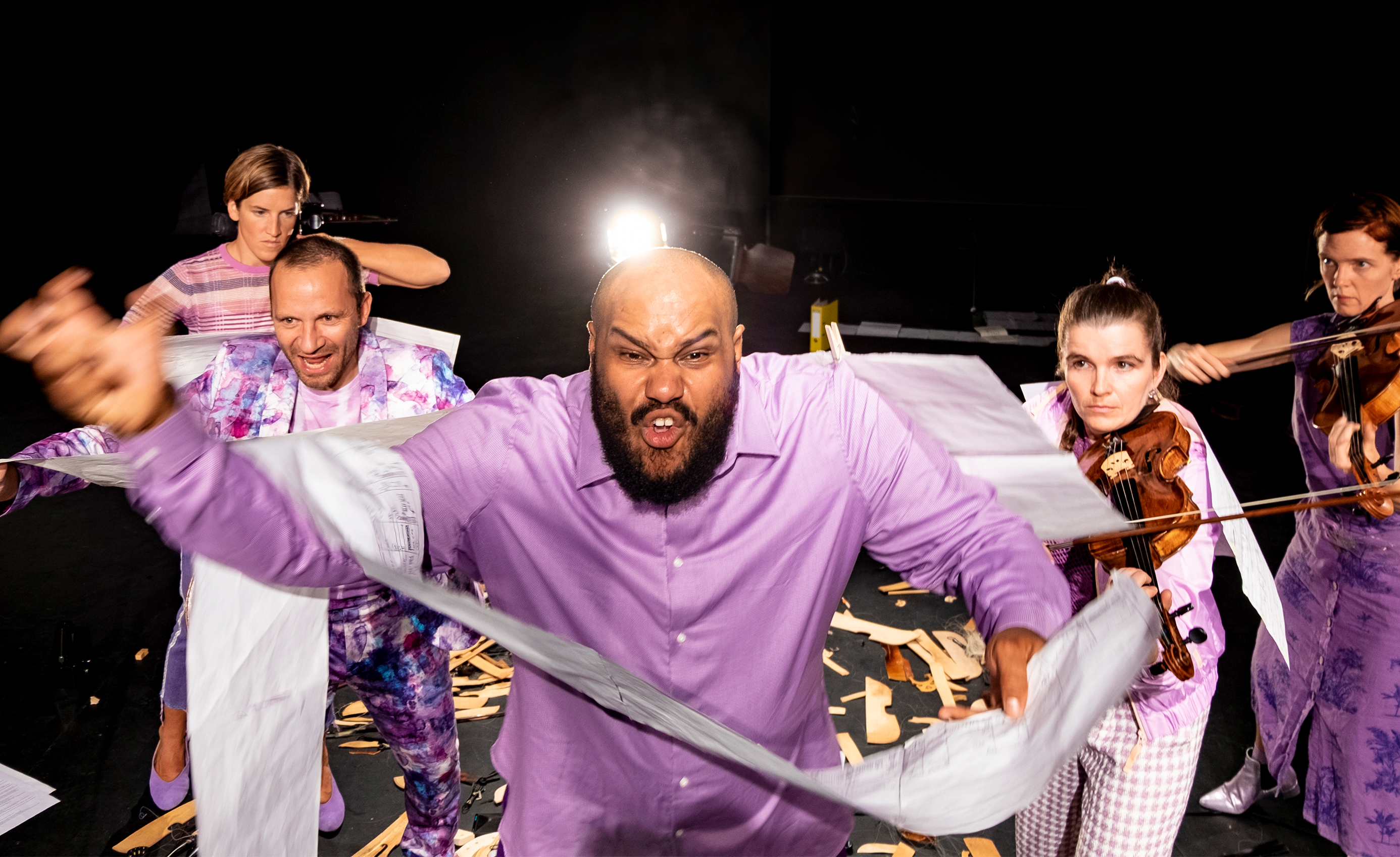
A production by Flinn Works and Quartett PLUS 1 / Das ist erst der Anfang e.V.
A project by Konradin Kunze, Simon Zigah (performance), Katharina Pfänder (violin), Lisa Stepf (violoncello), Kathrina Hülsmann (viola), Sophia Stepf (direction), Matthias Schubert (composition), Tatjana Kautsch (costume design), Annekatrin Utke (assistant director), Gijs Wisse (technical director), Helena Tsiflidis (production management)
Supported by the Berlin Senate Department for Culture and Europe, the Lower Saxony Foundation, the Lower Saxony Ministry for Science and Culture, the Lower Saxony Savings Bank Foundation, the Sparkasse Goslar Peine Hildesheim, the Hessian Ministry for Science and Art, the Cultural Office of the City of Kassel, the Hildesheim Civic Foundation, the Friedrich Weinhagen Foundation and the Gerhard-Fieseler-Foundation.
The project was made possible by flausen – young artists in residence, a scholarship model project by theater wrede+
In co-production with Sophiensæle Berlin and Theater Bremen
Sophiensæle Berlin: September 24 (opening) & 25, 2018 / Theater Bremen: October 20 & 21, 2018 / Staatstheater Kassel: October 23 & 24, 2018 / Theaterhaus Hildesheim: October 29, 2018 / Eisfabrik Hannover: June 27 & 28, 2019
How to achieve what one would hardly think possible: the setting of massacres to music. Musicians and performers (...) let sound collide with words. The words connect with the destroyed violins in the center of the stage. And from them, the gaze wanders back to the intact instruments of the musicians. The result is a powerful associative space.
theater der Zeit, 11/2018
The complex theme was transformed into the form of a performatively enriched concert by the artists in a work process lasting several years. Composer Matthias Schubert found impressive solutions for a project that initially seemed impossible. The idea of transmitting a radio message is outstanding: the strings and bows of the string instruments become signal transmitters - they are morphed. In addition, voices, breathed, whispered, roughened, letter by letter, lasting an eternity, transmit the command to ensure a “humanitarian catastrophe”.
taz, die tageszeitung
By giving a voice to the German terror in Rwanda in an excursus, namely that of Hermann von Wissmann, Kosa La Vita also refuses to take a frivolous position. Instead, the artists meticulously work out the difficulties of the process to the challenging music of composer Matthias Schubert. One might be reminded of The International Criminal Court, which Gintersdorfer/Klaßen presented at Theater Bremen around six years ago. However, Kosa La Vita is formally more stringent and more impressive in its relentlessness. It is regrettable that this important play could only be seen twice at the weekend in Bremen.
Kreiszeitung